The Financial Incentive Behind Mass Incarceration Is Detrimental To Our Society
The American Justice System Today Is Not Broken But Has Flaws That Are Exploited To Extort Millions of Dollars From Innocent Tax Paying Citizens Everyday
Did you know that in the U.S., an innocent person can be arrested and held in jail for years, separated from their family and work? They may be forced to pay for adequate legal defense, pay a bond for each charge or remain incarcerated, pay for unhealthy jail food, and even work for the jail, saving them money. If you are found not guilty, you are not entitled to a single dollar of reimbursement or compensation. This issue creates a financial incentive for mass incarceration, which in turn sows seeds of distrust not only in the judicial system and contracted private industries, but also in our government as a whole.
When someone is incarcerated, their life is thrown into disarray and their livelihood is put at risk. Bills can pile up, damaging their credit, and the mental and financial burden is felt by their family and loved ones. Even after an individual posts bond, the pending charge remains on their record until the case is resolved, potentially preventing future employment or making it more difficult to find work. Compensation is only available if you are wrongfully convicted and your case is overturned. However, only 48.5% of charges in Georgia actually end in a conviction. Earlier this year, our government nearly passed a bill that would provide a legal framework for innocent people who are wrongly arrested to seek reimbursement for undeserved punishment. This is Georgia Senate Bill 244.
The Facts Of The Matter
Trust In The System
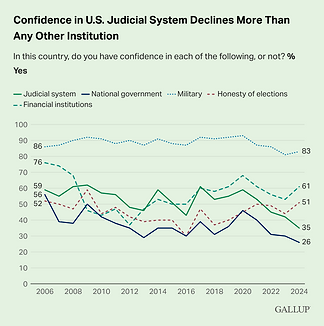
Confidence in the rule of law is foundational to a free society. However, Americans’ faith in the embodiment of the rule of law—the judicial system—has declined significantly in recent years. In 2024, only 35% of Americans expressed confidence in the honesty of the justice system. A new survey conducted by the Partnership for Public Service in the spring of 2025 shows that trust in the federal government remains low.
-
33% of Americans trust the government
-
47% do not
-
13% are neutral

Profits From Pain
The Entire American Prison System's Annual Turnover Is Estimated At Around $80.7 Billion.
Bail bond companies collect billions of dollars in nonrefundable fees from defendants and their families every year. The industry also actively works to block reforms that threaten its profits.
-In 2024, the GOP-dominated House voted 97-69 for Senate Bill 63, supporting a measure that would limit charitable bail funds or individuals from bailing out more than three people per year, reserving that ability only for those who meet the legal requirements to be bail bond companies.
-Bail bond companies earn roughly $2.4 billion annually.
-In 2019, an estimated $15 billion in bail bonds was written.
Commissary vendors that sell goods to incarcerated people—who largely rely on money sent by loved ones—also represent a large industry, bringing in $1.6 billion a year. After its merger with Trinity, Keefe was expected to generate $875 million in annual revenue, representing more than half of the total market value. Keefe is a subsidiary of TKC Holdings, which also owns other correctional service providers such as Access Securepak and Trinity Services Group.
The correctional telecom sector is a business that annually generates $1.4 billion in phone call revenue alone, with two companies, Global Tel Link (GTL) and Securus Technologies, controlling a majority of the market.
Inmate workers in the U.S. produce at least $11 billion in goods and services annually but receive just pennies an hour in wages for their prison jobs, according to a new report from the American Civil Liberties Union (ACLU).

